





-
Customer Strategy Services

Customer Analytics & Insights
Turn customer data into clear insights that improve targeting, campaign performance, and measurable growth.

Loyalty Program Design & Management
Build and manage loyalty programs that increase engagement, retention, and customer lifetime value.

CRM Channel Marketing & Management
Coordinate direct mail, email, and SMS strategies that reach the right customers and prove ROI.

Customer Lifecycle Marketing & Journey Mapping
Design connected journeys that move customers from acquisition to retention and repeat purchase.
Print & Marketing Execution

Direct Mail
Execute personalized direct mail campaigns that improve targeting, response rates, and measurable marketing ROI.

Email & SMS Marketing
Deliver timely, data-driven email and SMS campaigns that increase engagement, conversion, and customer retention.

In-Store Signage & All Things Print
Produce and deliver on-brand print, signage, and materials on time across every location.

Web-to-Print
Give teams one platform to order, customize, and control branded materials at scale.

Kitting & Fulfillment
Simplify complex distribution with accurate kitting, inventory control, and on-time delivery.
Branded Merchandise

Promotional Products & Branded Apparel
Curated, brand-right merchandise for campaigns, events, customer engagement, and everyday brand visibility.

Online Company Stores
Branded online stores that simplify ordering, inventory management and distribution across teams and locations.

Custom Kitting & Fulfillment
Custom kit assembly, warehousing, and reliable fulfillment for launches, events, employee programs, and customer campaigns.

Programs Built Around Your Goals
Brand-right merchandise solutions tailored to your audience, objectives, timeline and budget—from product selection through fulfillment.
-
-
-
.svg)
Why Baesman?
We combine data-driven strategy, seamless execution, and personalized support to help brands build more profitable customer relationships.

Data Security & Trust Center
See how Baesman protects customer data with secure processes, compliance standards, and a commitment to transparency.

Awards
Explore the recognition that reflects Baesman’s commitment to innovation, quality, service, and results.

Partners
Discover the technology and strategic partnerships that help Baesman deliver smarter, more connected marketing.

Careers
Join a team that values collaboration, growth, and doing the right thing for clients, teammates, and each other.
5 min read
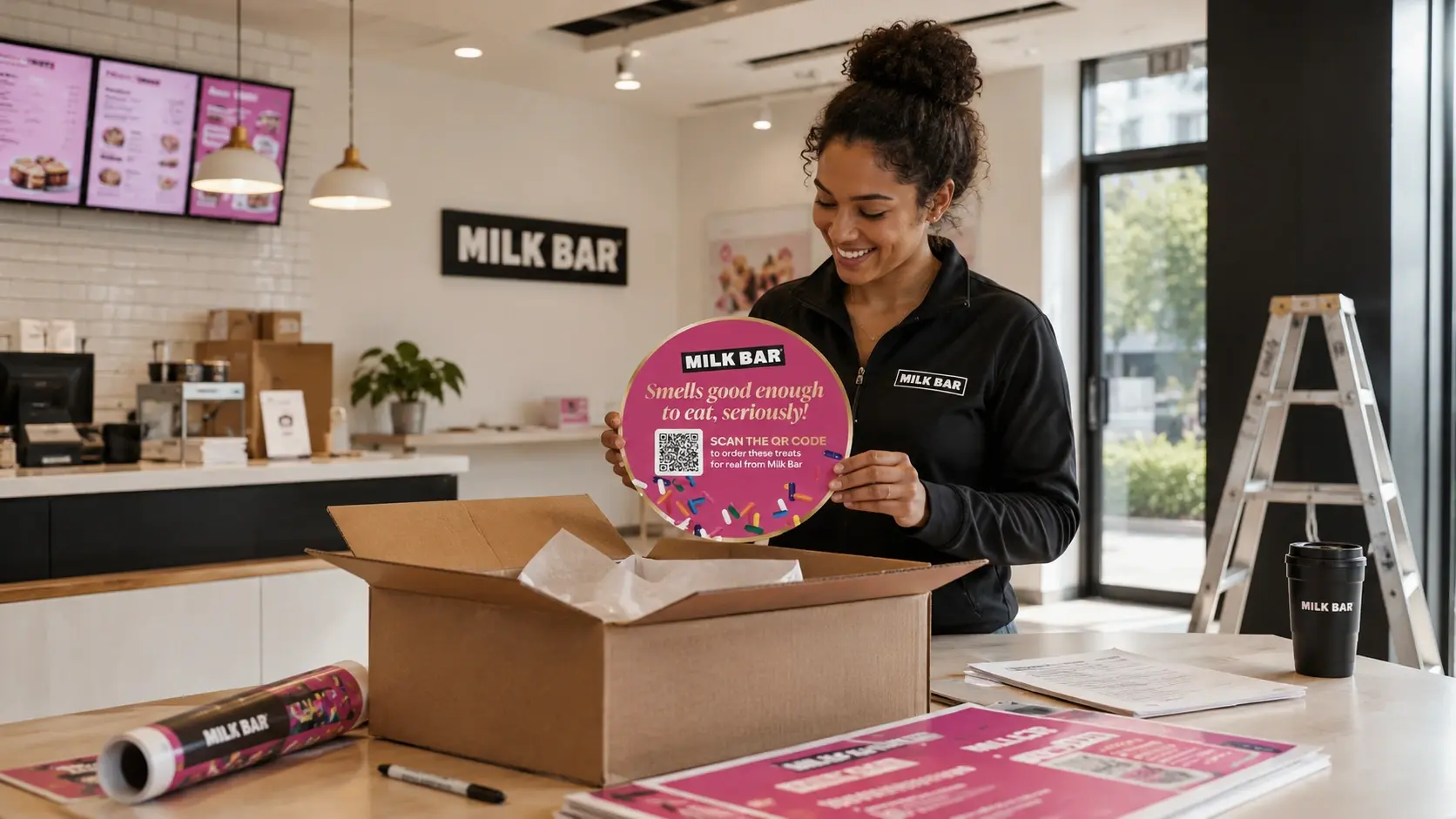
Branded in-store signage stays consistent across a growing retail network when templates, approval standards, and fulfillment are centralized, rather than left to individual store managers or franchise owners to interpret on their own. For retailers opening new locations or managing a franchise footprint, the real challenge is not designing good signage once. It is making sure every location displays the same approved, current version of it.
TL;DR: Branded In-Store Signage at a Glance
Branded signage usually breaks down at scale not because of weak design, but because of inconsistent execution from one location to the next.
- Centralized templates and approval standards keep every store on-brand without slowing down local promotions
- Web-to-print ordering and fulfillment are what actually enforce brand standards day to day, not a style guide alone
- New store openings and franchise growth are the moments brand consistency is most likely to slip
- Local promotions and branded standards are not in conflict when the right fields are locked and the right fields are flexible
For a look at signage as an omnichannel coordination tool rather than a brand governance one, see the companion piece, In-Store Signage: Connecting Physical Retail Space to Omnichannel Marketing.
What Makes Branded In-Store Signage Difficult to Manage at Scale?
Branded signage is easy to manage at a single location. It becomes difficult once a retailer has multiple stores, each ordering, printing, or displaying materials on its own timeline.
At ten locations, a marketing team might still catch inconsistencies through occasional store visits or photos sent in by managers. At fifty or a hundred locations, that manual oversight breaks down, and brand consistency starts to depend on how carefully each individual store manager reads a style guide rather than on a system that enforces it.
What Happens When Signage Isn't Centrally Governed?
Without central governance, individual locations often print their own signs, reuse outdated templates, or source materials from different vendors. One store may still be using last quarter's promotional signage while another has already updated, and there is often no easy way for corporate marketing to know which locations are out of compliance until a customer or field visit surfaces it.
What Changes When Brand Standards Are Centrally Enforced?
When brand standards are centrally enforced, every location works from the same approved templates and receives updates on the same schedule. Corporate marketing gains visibility into what is displayed where, and local teams get a faster, simpler way to order what they need instead of designing or sourcing it themselves.
What Should Brand Standards for In-Store Signage Actually Cover?
Strong brand standards for signage go beyond a logo and color palette.
They typically define:
- Approved templates for each type of signage
- Required legal, safety, or compliance language
- Sizing and material specifications for consistent print quality
- Which fields can be locally customized and which cannot
- An approval workflow for anything outside the standard templates
Without this level of detail, a style guide becomes a reference document that individual locations interpret differently rather than a standard they actually follow.
How Do Retailers Keep Signage Consistent Across Every Location?
Retailers keep signage consistent by combining centralized templates, an approval workflow, and centralized fulfillment into one system rather than managing each piece separately.
Does It Start With Centralized Templates?
Centralized templates give every location the same starting point for signage, so local teams are customizing within approved boundaries instead of building materials from scratch.
Does It Require an Approval Workflow?
An approval workflow controls what can move from a template into production. This matters most when a location wants to run a local promotion or event that falls outside the standard signage library.
Does It Depend on Centralized Fulfillment?
Centralized fulfillment closes the loop by making sure the approved signage actually reaches every location on schedule. A web-to-print platform lets store managers or franchise owners order approved materials on demand, while corporate marketing controls what can and cannot be changed. For a closer look at how this works in practice, see The Ultimate Web-to-Print Guide.
How Should Brands Handle Local Promotions Without Breaking Brand Standards?
Brands handle local promotions without breaking brand standards by locking the elements that protect the brand, such as logo, color, and required language, while leaving room for the elements that make a promotion locally relevant, such as a date, an event, or a regional offer.
For example, a regional grocery chain running a local grand opening promotion might let a store manager update the event date and address on an approved template, while the logo, color palette, and required signage language stay locked. The result is a piece that feels locally relevant without ever looking off-brand, and without corporate marketing having to review and approve every single local variation by hand.
How Does Brand Governance Affect New Store Openings and Franchise Growth?
New store openings and franchise growth are the moments brand consistency is most likely to slip, because a new location has no existing signage history to fall back on.
Without a standard new store opening package, a new location may default to whatever a local sign shop or vendor produces, which can look different from every other store the moment it opens. A centralized approach solves this with a pre-approved signage kit tied to store openings, so a new location launches with the same brand standards as a location that has been open for years. This is closely tied to the work covered in What Is Kitting and Fulfillment? A Guide for Marketing and Retail Teams, since a new store opening kit is a kitting and fulfillment problem as much as it is a signage one.
How Did Charley's Maintain Brand Standards Across a Growing Footprint?
Baesman's work with Charley's shows how centralized signage and fulfillment support brand consistency as a franchise footprint grows.
As Charley's added locations, keeping signage, promotional materials, and brand standards consistent became more operationally complex than any single store could manage on its own. Rather than leaving each location responsible for sourcing its own materials, the program connected fulfillment, marketing distribution, and brand governance into one system that scaled with the business.
That approach reflects what most growing retail and franchise brands eventually need: a way to protect brand standards that does not depend on every individual location getting it right on their own. It also gives corporate marketing a clearer picture of the network as a whole, rather than relying on occasional store visits to catch inconsistencies after the fact.
What Should Brands Track to Measure Signage Brand Consistency?
Brands should track whether their brand standards are actually being followed, not just whether signage was ordered and shipped.
Useful metrics include:
- Consistency audit score: the percentage of locations displaying current, approved signage during a spot check
- Time to compliance for new openings: how long it takes a new location to be fully outfitted with approved, on-brand signage
- Off-brand material rate: how often non-approved materials are caught and corrected across the network
- Franchise or location compliance rate: the percentage of locations ordering exclusively through approved channels
Tracking order volume alone, without measuring compliance or consistency, makes it hard to know whether brand standards are actually holding up in the field.
Frequently Asked Questions About Branded In-Store Signage
What is branded in-store signage?
Branded in-store signage is signage that follows a retailer's approved templates, colors, logos, and messaging standards, rather than materials designed independently by individual locations.
Why is branded signage hard to manage across multiple locations?
Because without centralized templates and fulfillment, individual locations often source their own materials on different timelines, which creates inconsistent branding from store to store.
How can retailers keep signage consistent across a franchise network?
By combining centralized templates, an approval workflow, and centralized fulfillment, so every location orders from the same approved system instead of designing or sourcing materials independently.
Can local stores still run local promotions with branded signage?
Yes. Brands can lock core elements like logo and required language while leaving specific fields, such as a date or local offer, open for local customization.
Why do new store openings often struggle with brand consistency?
A new location has no existing signage history to build from, so without a standard opening package, it often defaults to whatever a local vendor produces, which can look different from other stores.
How can brands measure whether signage standards are being followed?
Brands can track consistency audit scores, time to compliance for new store openings, off-brand material rates, and how many locations order exclusively through approved channels.
Final Takeaway: Why Brand Consistency in Signage Requires a System, Not Just a Style Guide
A style guide tells locations what branded signage should look like. It does not make sure every location actually follows it. That requires centralized templates, an approval workflow, and fulfillment working together as one system.
Retailers that build this kind of system protect brand consistency, support local promotions, and reduce the risk that a new store opening or a fast-moving franchise network drifts off-brand before anyone notices.
See The Ultimate Web-to-Print Guide for a closer look at how centralized ordering keeps branded materials consistent across every location.
About the Author